Choosing stock · 2 min read
How to Use Walnut Accents Without Buying an All-Walnut Board
How do I get a walnut accent into a little build with only a few walnut offcuts?
Offcut Journal editorialUpdated
Short answer
Use your walnut where it can carry the visual line you want. A single narrow front rail can do more for the finished look than several hidden pieces. Keep the specified material wherever the plan depends on it and choose accent stock of the right shape and actual dimensions.
At the bench
Make a face map from the usual viewpoint
Take a quick sketch from the direction the project will be first seen. Mark its long uninterrupted lines and visible corners. Reserve the best dark pieces for those lines if they help give the project a coherent look. Check the view from above too, since a narrow decorative edge can also be a common touch surface.
Keep visual and construction roles distinct
An accent can be a sound full-size part, or it can be a decorative layer on a physically complete project. Those roles call for different checks. If the darker part replaces a rail, it must suit the established size and function of the rail. If you are adding a separate decorative face, account for the extra thickness where the item meets a shelf or slips into a recess.
Let several smaller pieces play a different role
Two small scraps that cannot make a full rail may still form matched ends or feet where the grain and dimensions fit. Put them in position and compare their colors with the surrounding pieces before cutting. Save the longest grain for a separate uninterrupted line where a repaired or pieced pattern would draw attention.
Verify the contrast on the actual pair
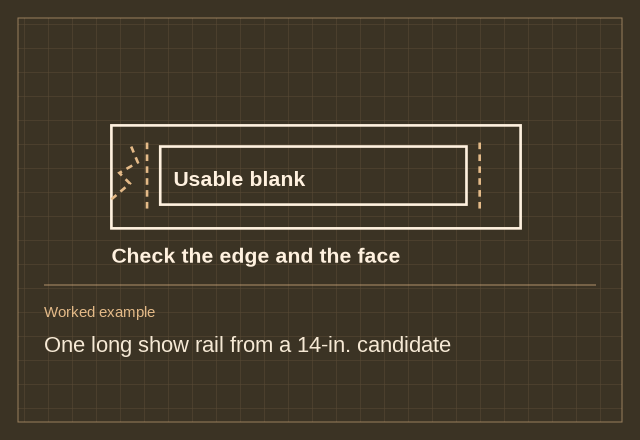
Look at the walnut and the lighter material under the same room light. A narrow darker streak may look almost black in low light and more muted in daylight. Keep the comparison focused on the actual trimmed faces. Mark which side faces out so that the layout you chose survives moving the blanks to the bench.
Choose between a walnut accent and a birch seam
For the accent rail, compare a clean walnut strip with the existing birch edge before adding material to the front. Place the loose strip against the planned rail and look at the junction from the side. A laminate accent can produce a visible end line where a solid replacement rail produces one continuous section. Measure the outside size and check whether the edge goes through an opening or meets an adjacent panel. If a thin added accent makes the build too deep, put the contrast on a separate visible part whose dimensions can remain as specified. Reserve the long walnut blank until the mockup shows where it earns its place.
Practice on a plan
Finished dimensions in width × depth × height order.