Choosing stock · 3 min read
How to Budget Thickness for Two Blanks From One Board
Is my board thick enough to supply two finished blanks?
Offcut Journal editorialUpdated
Short answer
Add the two required finished thicknesses, the material lost at separation, and cleanup allowance for both new faces. Check the least available thickness over the full part outlines. Thin matched pieces can need more starting stock than the arithmetic total of the pieces.
At the bench
Define the finished blanks first
Read the required thickness where the pair interfaces with grooves, side rails, or another part. Identify how much of each piece needs to stay that thickness. A bevel at one far end can still require a full-width rough blank until the matching end is established. Draw finished-size outlines on paper and use them to compare viable locations. The calculation is only useful for stock that has enough length and width after damaged edges are excluded.
Budget material losses from your own setup
A material-loss number depends on how the blanks will be produced. Use known dimensions from the service or equipment and see any sample they can provide. For surface cleanup, compare the texture and flatness of comparable stock from the same process. The example allowances above only illustrate arithmetic. Many boards need more cleanup on one face because a low area sets the working thickness for the rest of the blank.
Account for released movement
A board can change shape after it is divided, so the two fresh faces may not stay straight. Set aside enough surplus for stock correction and an alternative pair if suitable material is scarce. A hidden face can still need to lie flat against its support. If the starting piece is barely thick enough on paper or the equipment's capacity is uncertain, buy two compatible pieces at the needed thickness or have a supplier prepare them.
Check the project before combining calculations
Some plans accept separate thin pieces as long as the visible faces harmonize. Set two existing samples upright at the intended viewing distance before incurring the cost of matching slices. For a left and right face that sit an inch apart, the matching topology may matter. For parts several feet apart, using two consistent boards can be easier. Keep the chosen provenance on the cut list so the blank size remains clear if you reorder.
Find the smallest measured surplus before ordering
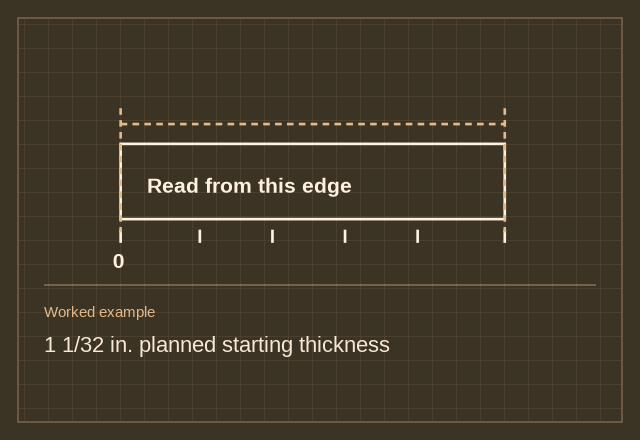
Record a few thickness readings inside each planned outline and find the smallest one that still has sound faces. If the thinnest usable location reads 1 1/16 inches and your worked starting requirement is 1 1/32 inches, the measured surplus there is 1/32 inch. That leftover amount must cover any loss beyond the example assumptions. Check whether it is still available after you exclude a cupped or tapered edge. If one length of the outline falls short, try moving both blanks together to a better position or order thicker known stock. Use the minimum reading when you compare two otherwise similar options.
Practice on a plan
Finished dimensions in width × depth × height order.