Choosing stock · 3 min read
How to Use Solid Offcuts of Different Thicknesses in One Project
Can different-thickness wood scraps go into one small project?
Offcut Journal editorialUpdated
Short answer
Use matching stock wherever parts locate, share a flat plane, or have the same profile. Give other offcuts to roles that fit their measured thickness without changing the design. On a small build, a one-eighth-inch difference can alter a visible seam or stop an object from fitting.
At the bench
List thickness dependencies before looking at scraps
Circle every cut-list item tied to a slot, outside width, fastener depth, level surface, or resting elevation. If the same letter appears more than once, line up those pieces in a matching group. A desk stand could have two sides holding a stored object at the same height and one independent front detail, yet the plan may still need the front's face to line up precisely. Mark what needs a confirmed match before ruling it independent.
Measure wide and long scraps more than once
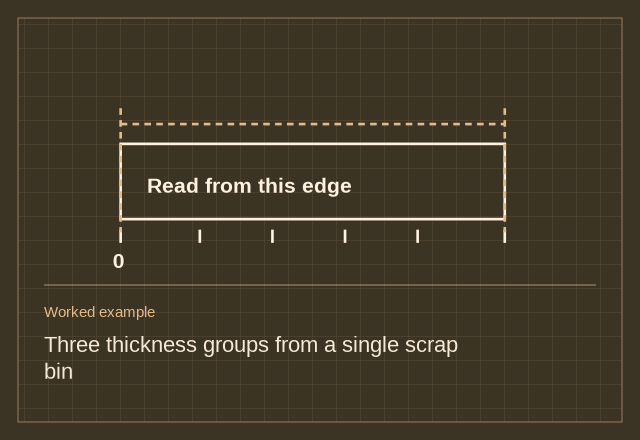
Use the ruler or caliper suited to the tolerance of the plan. Take measurements at opposite edges and ends inside the prospective blank. A rough underside or slight taper can make the first reading overstate what can stay in the part. Write the smallest useful thickness, available length and width, and any area that is out of tolerance on masking tape. Sort against the stock already specified.
Compare parts with the mockup assembled
Stand two likely side blanks on one verified flat reference. Hold an uncut base at the plan dimension underneath them and set a representative object against the intended bearing edges. Check side-to-side clearance and the way the finished faces align. Keep end locations and fastener allowances the same as the plan when a contact face depends on them. An independently sized accent can often sit in its original location without requiring any change.
Store leftover parts by possible role
One long offcut can supply the odd blank in a future project if you can find it without searching three old mixed piles. Mark actual dimensions and reference face before putting it away. When a mixed set has been allocated, keep a cut-list note about which stock supplied the repeat parts. If one gets damaged, a replacement drawn from the correct group preserves the same working geometry.
Set aside a look-alike part before it joins the wrong stack
Lay a true ½-inch side blank and a 5/16-inch spacer on the same flat bench and compare their mating faces with the planned ¾-inch base. Putting the spacer in the side's position would change that face by 3/16 inch even if the outer outline happened to match. Label the space and face each piece will occupy as soon as you cut it. Use the stock letter and the observed thickness on the cut list, especially if the woods look similar. The thin scrap keeps its useful spacer role while both sides still reach the same intended plane.
Practice on a plan
Finished dimensions in width × depth × height order.