Choosing a project · 3 min read
Tea Packets or Coffee Filters? Build Around the Way You Take One
What changes when an organizer holds loose coffee filters instead of wrapped tea?
Offcut Journal editorialUpdated
Short answer
Tea packets need lanes they can stand in and a low front for thumb access. Coffee filters need broad support and open space for separating soft nested paper.
Compare the builds
These dimensions belong to the linked plans.
Finished dimensions in width × depth × height order.
What to compare
Sort by the stiffest seam
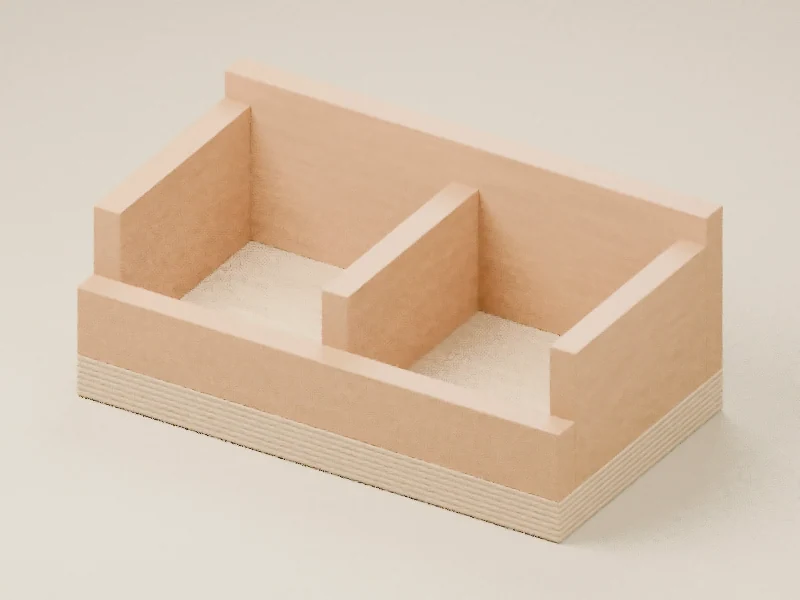
Stand the widest tea wrapper like a letter, then rotate it and see whether its printed name remains visible. Measure at the outer seam and include the small corners that catch when a row tilts. The caddy offers two equal compartments with a fixed center divider and 4 inches of clear depth. Leave room for your fingers to divide the row at its center. A snug row held upright by friction may be slower to use than a partial row left with some tilt.
Try the last few filters in a stack
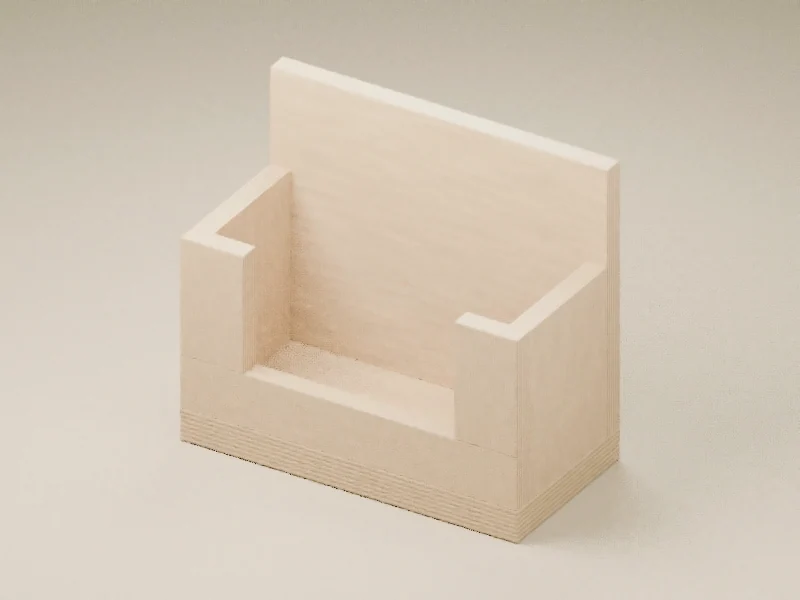
A nearly empty filter stack has less stiffness than a new package. Stand three filters in a box with a temporary low front and upper cheeks. If pulling one from the center bends the rim sharply, compare lifting through the opening above the sill or from the top. The full-height rear panel supports paper when it leans back. Trace your usual movement with the specific filter shape you buy, including hand space and the underside of any upper shelf.
Separate the counter's dry patch
Find a spot to one side of the usual wet work where an open stack of paper will remain dry and clean. The coffee holder is 8 × 4 inches at the base and 7 inches high; the tea caddy is 9 × 5 inches at the base and 3¾ inches high. Mark each footprint and compare it with where a water kettle, coffee dripper, or spoon actually goes. Leave enough space to refill each organizer without reaching over a hot or wet surface.
Watch the joinery at the service edges
The tea caddy has a long, low front rail that keeps packets from sliding out. The filter holder uses a sill and two higher cheeks that leave the center open. Both depend on accurately locating thin edge parts. Check your actual plywood or wall-stock thickness where it subtracts from the usable opening, especially if you adapt a sample width for imported or wider packages. A different wall thickness changes the aperture even when the outside stays fixed.
Give mixed filter shapes a separate nesting test
A flat basket filter and a folded cone may both fit the holder's 7-inch internal width while behaving differently together. Leave the small stack of one kind at the front of a cardboard mock-up and put the larger stack behind it. See whether the front stack keeps its shape when the back stack leans against it. If you have to shuffle the entire group to get the right filter, dedicate the wooden holder to one shape and return the other to its labeled package. In the tea caddy, the fixed divider makes separating two kinds straightforward if each awkward wrapper clears its own 3¾-inch opening.