Choosing a project · 3 min read
A Folded Signature and a Flat Sheet Need Different Work Surfaces
Can I use a sketchboard as a bookbinding punching support?
Offcut Journal editorialUpdated
Short answer
Choose the cradle when a folded signature must stay registered against a replaceable strip. Choose the board when a flat sheet needs a firm, clipped face for drawing or writing.
Compare the builds
These dimensions belong to the linked plans.
Finished dimensions in width × depth × height order.
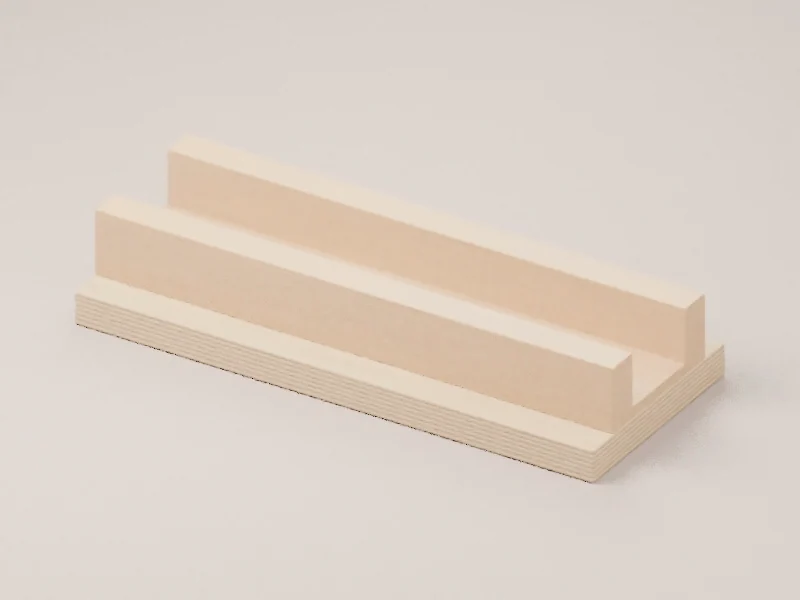
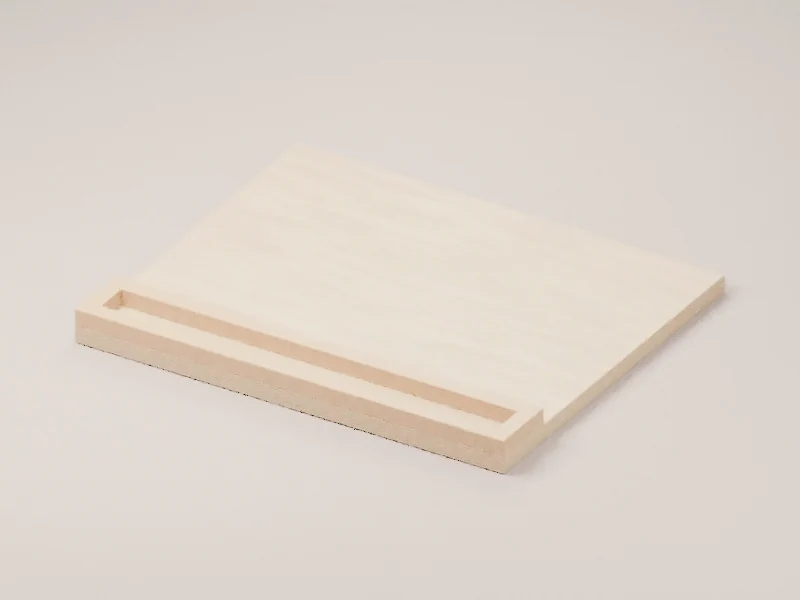
What to compare
Locate the edge the work depends on
Fold a scrap of paper to represent the signature and put a pencil line along its crease. That crease is the reference for the holes. The cradle stands it over a sacrificial backing strip, with parallel sides controlling where the fold rests. A flat writing board gives a surface and edge stops for clips. Model its contact points and see which corners are held and where the sheet could swivel if the top corners are not equally registered.
Check cover movement as well as paper thickness
A thicker stack may push its rounded fold to one side against a fence. Make the sample from the same stock and sheet count as the real work. Compare where the top sheet crease sits with where the fold contacts the bottom of the cradle. On the clip board, test with a single sheet and with the full stack you sometimes take outside the workroom. A clip that holds one position on a stiff board may still tilt a thick stack and lift its opposite corner.
Give the holes their own sacrificial surface
The cradle uses a ¼-inch-thick lift-out softwood insert. Inspect the old marks in that insert for places where a new point could fall into an existing hole. When renewing it, verify the replacement's actual thickness so it sits flat. Follow safe preparation for the tool you use and keep hands clear along the expected direction of travel. The sketchboard’s main panel is its working face. Old holes or debris could telegraph through the paper to the drawing surface.
Reserve a clean place for moving finished sheets
The cradle can stay on the workbench while pierced signatures move to a dry, flat place. The sketchboard can travel with a clipped sheet as a unit, provided clips are stable and protruding pencils are accounted for. Try both arrangements with a sheet of scrap and keep small paper edges where they cannot catch another tool. The most helpful board is the one that keeps the correct reference when the paper returns from the step before.
Mark the top of each paper stack before it leaves the fixture
Put a removable mark on one end of a folded trial signature and set it on the 12-inch backing strip with the mark toward the same end of the cradle every time. This is especially useful if the hole spacing is intentionally asymmetric. A crease 8½ inches long leaves 3½ inches of spare length, so always locate it from the same physical end or a single reference line. On the sketchboard, mark one corner of the back of the sheet if it needs to go back into a matched clipped position. Keeping those orientation marks consistent solves a different problem from holding the paper still.