Fixes at the bench · 4 min read
How to Fix a Small Wood Project That Rocks
Why does my small wood project rock on the bench?
Offcut Journal editorialUpdated
Short answer
Empty the project, clean its contact points, and turn it 90 degrees on a surface you’ve checked for flatness. If the same corners lift as the project turns, inspect the project. If the trouble stays at the same spot on the bench, check the surface before touching the wood.
Find the cause
Set up a reliable corner test
Take everything out of the tray or stand. Wipe the underside and a patch of bench large enough to turn the piece. Use a straightedge across both diagonals and along the edges of that patch. If the straightedge rocks, or shows light under the middle, try a different spot or a known-flat panel. A stable surface can still be uneven. The test calls for a flat reference, even if the surface slopes a little. Press each corner separately and mark the corners that lift in pairs.
Read the contact points from underneath
Look for proud screws, a dried glue bead, or a pad that has peeled or folded at a corner. A thin strip of paper slipped under each corner is a convenient contact check. If it pulls freely from one pair of corners while the other pair grips, the base is resting on a diagonal. Compare the underside itself with a straightedge. On a project with two separate runners, also check each length and then bridge both runners at the front and back. A runner can sit high even when the base panel is flat.
Decide what needs to change
If a screw is the obstruction, verify the screw length and the material left below its head before deepening any countersink. On a dry assembly, check that both rails seat fully and that the clamps aren’t pulling the base out of wind. A cured piece with a bowed plywood base may deserve a new base. Small independent pads can be fitted for the final resting surface on a light display stand. Keep the support stable from front to back and side to side. Sanding every corner tends to remove useful reference points before you know which one needs attention.
Recheck where the piece will live
Set the piece on its intended shelf or desk and repeat the corner test before putting anything back inside. Check once more with a representative load, like the book you’ll actually lean on a stand. A dresser top with a ridge under the middle can bring the problem back. For future builds, do the same check with parts dry-clamped and again just after tightening, while you can still adjust a joint. Write down the corner that lifted so you can tell whether your change fixed the original problem.
A flat base can still misbehave in use
A stand that sits quietly when empty can tip when something presses beyond its feet. Try the intended book or tool in the usual position while keeping one hand ready to catch it. Then move the object toward the middle of the support and see whether the lift disappears. If you can reproduce the lift only when the weight moves forward, you have learned something different from the empty corner test. Set a straightedge alongside each pair of feet and look at where the weight bears in relation to those lines. An overhanging piece may need a wider stance or a different job before you rely on it. Check whether a stiff cable or another object is pushing it as well.
Read the gaps under different feet
A four-foot riser that rocks between two diagonally opposite feet gives you two likely contact points to investigate. Put a piece of tape beside each foot and label them. On the flat test surface, lightly steady one high corner with a removable slip of card, then pull a strip of paper from beneath the other feet. Write down which points touch with the card in place. Take it out and repeat at the opposite high corner. This will tell you more than the thickness of one gap alone. For a lightweight piece with replaceable feet, inspect and compare the feet first. If you find a short one, fit a sound replacement before altering the rest. Recheck after moving it to the shelf.
Check whether a rigid base behaves differently on carpet
An entryway rack can be solid on a known-flat panel and still lean toward its front when it rests on a deep mat. Test with the rack empty on the intended floor, then on a rigid, flat panel on the same floor. Keep a hand ready to steady the rack and press over each support, watching the gap relative to the floor or panel. If individual feet sink into the mat before the base starts to rock, shifting the position or finding a firm floor is the first correction. A shim fitted to compressed pile can make the same build rock when you move it to bare flooring.
Practice on a plan
Finished dimensions in width × depth × height order.
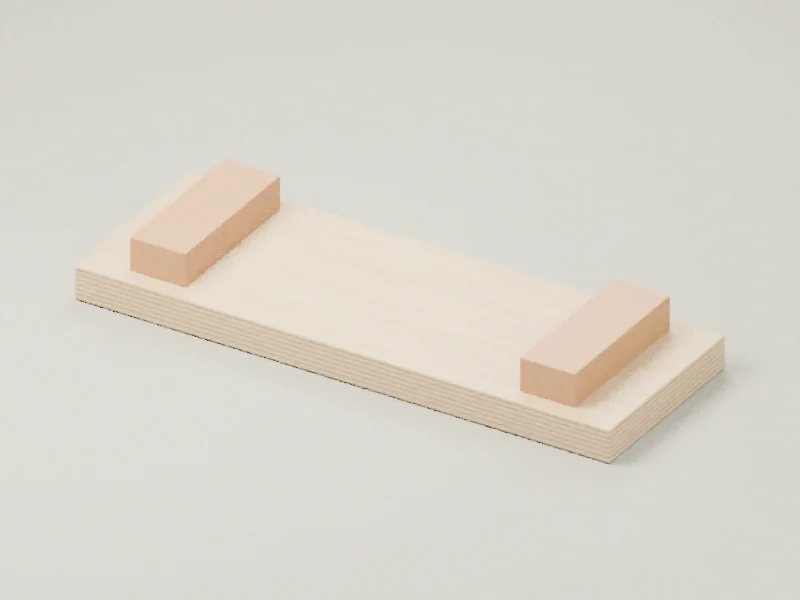 Two-Rail Wooden Rest for a Hand PlaneFinished size · 12 × 4¼ × 1½ in.
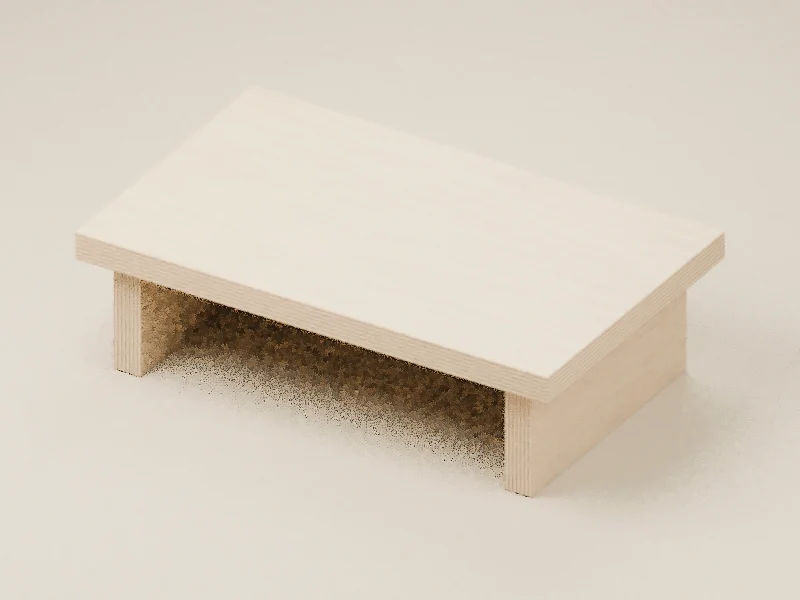 Low Wooden Mug Riser with Space for SaucersFinished size · 13 × 8 × 3¾ in.