Choosing stock · 4 min read
What to Do With a Cupped Wood Offcut
Can a board with a curve across its width still yield a useful small part?
Offcut Journal editorialUpdated
Short answer
Press one corner and the opposite corner lifts. Before you call the blank cupped, check whether the problem runs across its width or diagonally through the whole piece.
At the bench
Name the direction of the shape
Check the cross-section at the front, middle, and back. A consistent hollow across the width points to cup. A curve along the length is bow. Opposite corners lifting as you move pressure around the piece can indicate twist. Those shapes can appear together. Put your straightedge on a piece you already trust to see what a flat reading looks like. If the bench itself has a dip, the gap beneath your scrap is hard to interpret.
Judge the stock through the part’s actual footprint
Draw the finished outline on the board. Put a straightedge within the proposed part instead of referring only to the original board width. A narrow strip near one edge may have less cup across its smaller width, although it may still rock along its length. Take a reading at both ends and in the middle of the drawn strip. Select a different piece if the part must meet a flat mating surface and the joint shows a meaningful gap.
Take the pressure off before deciding
Set the stock down unclamped. Pushing a cup flat by hand tells you how much force a joint might have to resist, and says little about how it will behave when released. A flat base should stay flat on a bench without help. Avoid using a distorted blank in a machine setup that requires it to sit flat or run against a reference. Use a stable replacement or have sound stock prepared for the job. Save the irregular scrap for a suitable noncritical use only if it can be securely handled.
Allow a rough part to settle
Wood can take on or give off moisture. A smaller piece taken from a visibly stressed or unevenly dried board can change shape again after it’s separated. If you decide a sound lane is worth using, leave yourself stock for a final check and don’t fit a precise joint the same moment the blank changes. Set it where air can reach both faces without loading it against the bend. Recheck its shape before building around it. If the piece has two possible assignments, try the one with a forgiving fit first. A narrow, flat scrap can become a spacing gauge. A base or long divider asks more of it. Mark the intended job beside the measured gap so the same scrap doesn’t keep coming back as a candidate for a flat base.
Measure the flat stock a base would actually need
Hold the offcut beside a known-flat blank of the thickness the plan expects. Check which faces the finished part needs to present, and how far its fasteners or housed edges extend through the thickness. A thickness reading at one high edge can hide the material you would have to remove elsewhere to make both faces flat and parallel. For a small base, compare the stock choice with the narrowest remaining section the design calls for. If you have suitable equipment and experience to true the wood, start with a sufficiently oversized, safely supported blank. A ready-flat replacement is an easier way to preserve the dimensions in the cut list.
Check the other direction before assigning a job
A strip that appears flat across its width might carry a slight bow along the edge that needs to register throughout its length. Stand a known-straight scrap beside the marked strip and compare the faces that will meet, with the pieces unloaded. Slide a shim into any visible gap and note whether it remains at the same spot when you turn the candidate end for end. Then try the idea with the real part. The face of a quick stop might only need a short, stable bearing area. A rail that runs along a tray edge needs to meet continuously along a larger face. Make that distinction before setting the final length.
Test whether a narrow blank can use the original reference face
When a cupped board still looks promising for a narrow stop, tape the exact width of the stop onto the hollow face. Set a short straightedge entirely inside those tape lines and compare the gap at three points along the length. A narrow lane may look flat at one end even though its contact face pulls away from a mating rail farther along. Lay the stop outline in a different lane if one is available, then use the mating rail itself for a final unforced check. Leave the lane unsized if the stop needs enough thickness to recover a flat support face. A clamp can hold a trial part but cannot tell you how the faces actually register unloaded.
Practice on a plan
Finished dimensions in width × depth × height order.
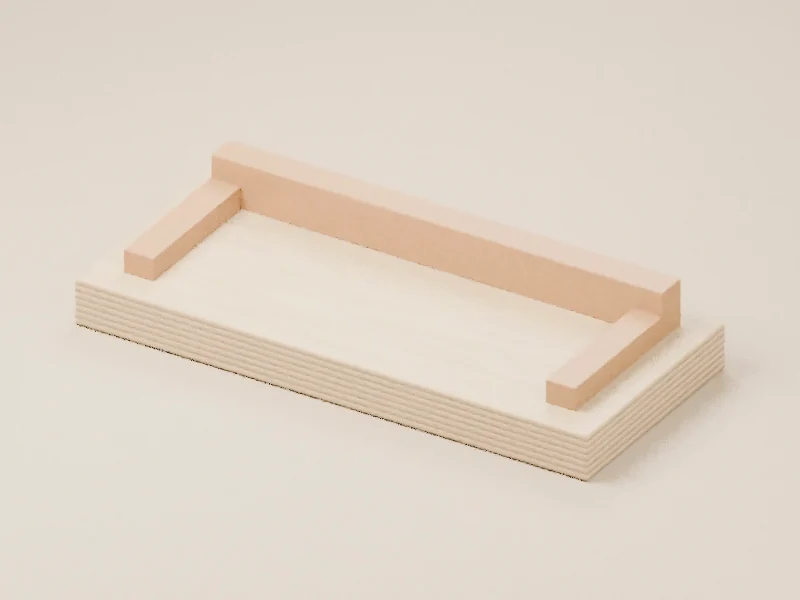 Open-Front Wooden Eyeglass HolderFinished size · 8½ × 3¾ × 1½ in.
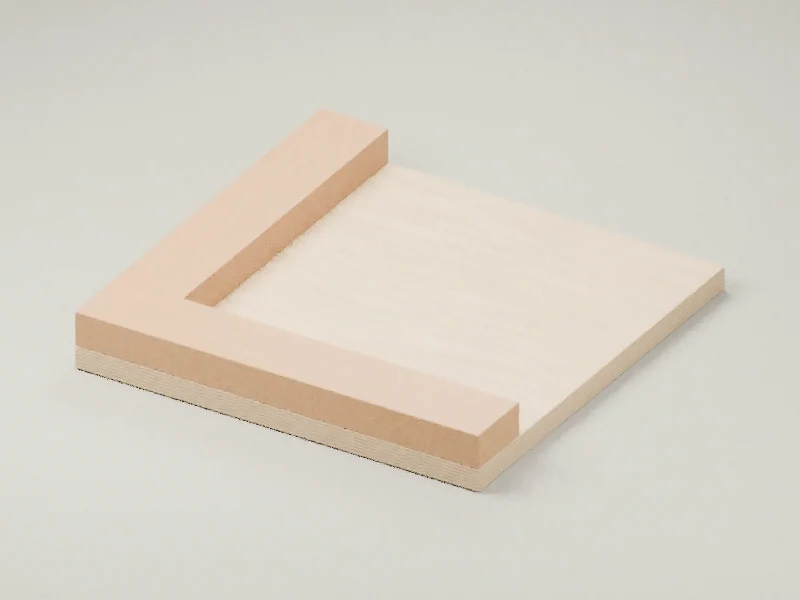 Wooden Right-Angle Jig for Box Glue-UpsFinished size · 9 × 9 × 1¼ in.