Choosing stock · 2 min read
How to Compare Lumber Prices by Usable Parts
Which board is cheaper when one yields fewer good parts?
Offcut Journal editorialUpdated
Short answer
Compare what the boards yield for the particular build. A board with a lower price or more area can cost more if the uninterrupted grain you need occurs in only one place. Draw each required blank on the board you can actually buy.
At the bench
List the parts that constrain the purchase
Write down finished sizes, then mark which stock needs room for trimming or surfacing. A long rail, a matched pair, and a large clear panel usually leave fewer placement choices than small spacers. Lay these parts out first. A piece that can be cut from several corners of the board can wait until the more demanding outlines are spoken for.
Draw boxes around flaws
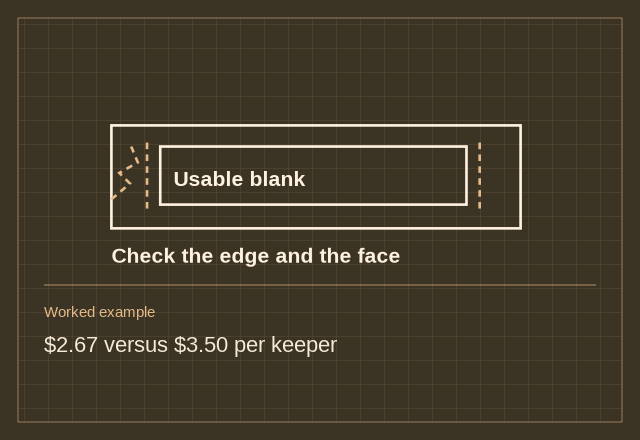
Study both faces and look at each edge before counting a region as clear. Give a knot that reaches the edge or a corner that needs straightening its own crossed-out area. Leave room between candidate blanks for whatever cuts will separate them. This step matters for an irregular discount board that looks generous when you count all its area as usable.
Price the list that goes home
If two boards are needed to finish one project, use the combined price for the comparison. Keep the projected price per part as a second figure for comparing options. Ask whether a leftover would actually match a future problem you have, such as an extra rail from the same stock. A short irregular piece has value when you can name what it fits.
Keep a spare where it matters most
A spare made from the same stock helps when a part needs to match its partner in color or thickness. You might count one extra strip for a trial cut and leave the panel layout alone. If the spare would force a second purchase, mark that decision on the drawing so you can compare the price with a different board.
Price the board with your shop's purchase minimum
A supplier may price a board by length but sell only the whole piece, or cut a clean section at a different rate. Ask what will appear on the bill before comparing the $8 and $7 boards in the example. Put the actual charge beside a drawing of the parts and any work the supplier will do. Check whether the service trims both ends or just makes the board short enough to take home. A 24 in. take-home length cannot yield three exact 8 in. strips after separation and end cleanup. If a cut is included, show the seller which clear section contains the three outlines before it gets shortened.
Practice on a plan
Finished dimensions in width × depth × height order.