Choosing stock · 3 min read
How to Read Hardwood Grades for Small Clear Parts
Does a lower hardwood appearance grade still work for short, clear parts?
Offcut Journal editorialUpdated
Short answer
Hardwood appearance grades describe possible clear cuttings using grading rules. Grade can help compare stock, while a full-size outline reveals whether your project's dimensions fit the board you can actually buy.
At the bench
Find out how the seller applied the grade
Look on the tag or ask the seller for the grading system and whether the lumber was surfaced or further sorted after grading. NHLA publishes standard hardwood grading rules and applies species-specific exceptions. Retail labels such as premium and select can describe local sorting and need not identify an NHLA grade. The exact appearance standard matters when ordering sight unseen. When the board is in front of you, use the label to guide inspection and assess the actual stock.
Translate a clear cutting to your finished piece
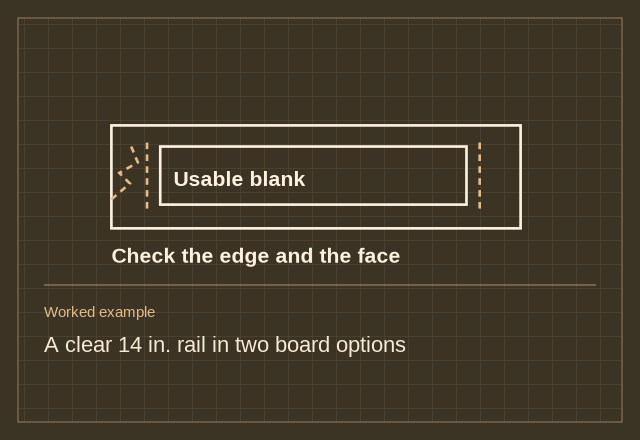
A clear cutting in a grading rule has its own dimensional criteria. Your piece might need a reference edge, two good faces, or a continuous grain match with its neighbor. Lay a paper part pattern over two possible positions. Check the edge and reverse as well as the show face. The number of short clear boxes on a board matters more for a batch of pads than the longest fully clear stretch.
Keep other board requirements separate
Appearance grading is distinct from system-specific structural design requirements. It does not establish that a particular board is dry enough, flat enough for your projects, or safe for an application with higher demands. Check actual thickness and edge condition. Reserve the longest clear area for the part with the least placement freedom. Use a short clear pocket for a small blank only if the neighboring defect will stay outside the rough trim envelope.
Compare quoted stock in pieces you need
A seller may quote by board foot, length, or an entire prefabricated item. Estimate how many complete blanks each board can supply after trim. If two clear but short pockets each provide one pad and a third will need another purchase, include the second purchase in the comparison. Keep the grade note with the measured layouts when placing an order so any seller substitute can be checked against both.
Ask the supplier for one dimension the grade cannot communicate
When you order by sight unseen, describe the job in actual piece sizes. The sample project needs one clear 14-inch rail after trimming, so ask for at least that usable length plus your preparation margin in one uninterrupted place. Also say if both faces will show or if a straight grain run matters at a narrow edge. Long enough stock and a named appearance grade do not necessarily answer either question. Compare the supplied dimensions with your paper outline before allocating the shorter clear pockets to pads. If a seller provides a photo, use it to request a measurement instead of estimating the rail by eye.
Practice on a plan
Finished dimensions in width × depth × height order.