Choosing a project · 3 min read
One Glue Brush or Five Clean Paintbrushes? Where the Tips Go Matters
Should a bench brush rest catch drips or hold brushes apart as they dry?
Offcut Journal editorialUpdated
Short answer
Build the glue rest when a wet applicator parks briefly above a removable liner. Build the paintbrush rack when several clean brushes need separate drying lanes.
Compare the builds
These dimensions belong to the linked plans.
Finished dimensions in width × depth × height order.
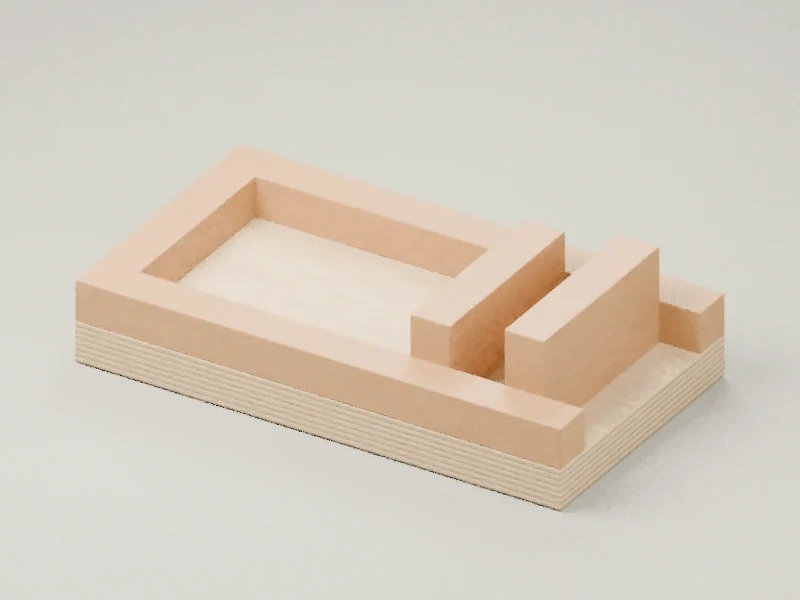
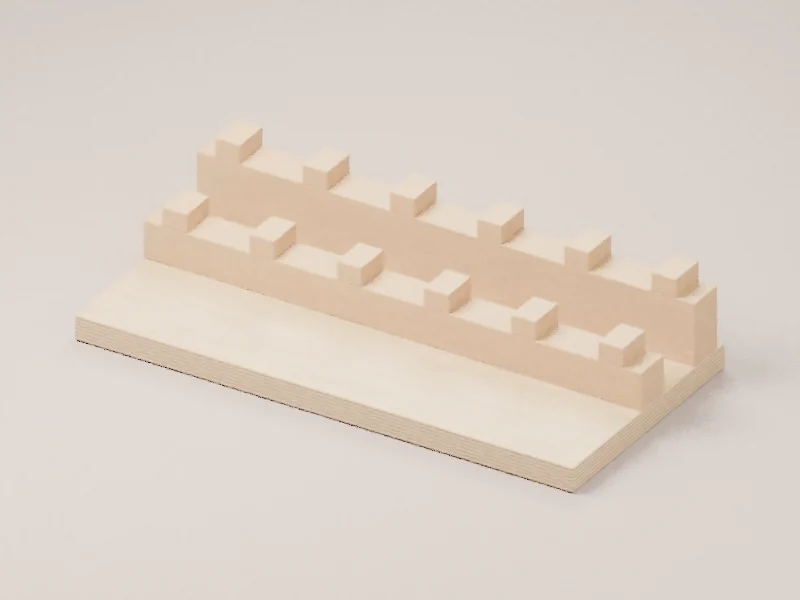
What to compare
Place a resting brush at the angle it naturally takes
Set the brush on two scraps at the heights where you expect the supports to sit. The glue rest has support tops at 2¼ and 2½ inches above the bench. Let the handle settle and note the tip’s actual projection, along with the section that contacts each support. A round handle can rotate. If that rotation takes the tips sideways or downhill off the liner, adapt the contact shape before deciding whether the project is useful for the applicator.
Trace bristle reach independently of handle reach
The paintbrush rack’s front support is ½ inch lower than the rear support. The layout keeps clean bristles away from the board. Compare a short brush and a long brush across a simple representation with 1¾ inches between corresponding support faces. Mark where each ferrule sits and where each tip hangs. A short handle may fail to bridge the supports even while its bristles look like the ideal width for a lane. Try all the brushes you intend to dry.
Decide when each station is cleared
A glue rest sits inside an active workflow. Put it where you can set down the applicator without reaching across a glued seam or a projecting clamp, and lay the removable liner where you can lift it after the job. A drying rack can occupy a quieter corner once brushes are clean. Check that the wet brush tips remain clear of walls and the bench below. Follow the brush, paint, and adhesive makers’ directions for cleaning and drying.
Make daily cleanup visible from the front
On the 9 × 5-inch glue rest, confirm the liner can lift out with the handle resting elsewhere. A shallow board that has nowhere to put a sticky brush during cleaning may leave the operator searching for another surface. The 10 × 5-inch drying rest divides five handles and leaves their ends where you can see them. Mark one stop for an odd-sized brush if its easiest location is not interchangeable with the other four.
Check what falls beyond the resting brush
Set a clean piece of paper under the full length of each parked applicator and trace its ferrule and bristle ends. On the glue rest, the inside 3½-inch width is useful only if those likely drip points project over the removable liner. A longer handle can move the ferrule outside the covered area even when the bristle tips fit. On the drying rest, look at the bristles hanging clear of the front support and put the rack over a compatible, protected surface if water can fall below. Keep drying brushes away from the fresh assembly area. Choose a site you can wipe without moving the other station mid-job.