Measuring and layout · 2 min read
How to Trace a Boot Heel for a Seated Boot Jack
How wide should a boot jack opening be for a heel that flares near the sole?
Offcut Journal editorialUpdated
Short answer
Measure where the opening will contact the boot. Draw that shape on card and include any narrower or wider profile immediately below it. A seated mock-up can show how the heel enters and where the contact occurs before you cut a durable slot or fit a liner.
At the bench
Find where the opening actually bears
Set the boot on a stable surface in the orientation you would insert it. Draw lines on card at the heights where it might contact a wood notch. A thick tread can be wider than the leather heel just above it. Note whether the throat is intended to stop on the sole edge or a narrower area higher up.
Trace the motion on a reusable card
Use a firm card or thin foam with marks for both sides of the proposed opening. Move an empty boot by hand into the trial cutout. Adjust the mouth before you change the curve at the throat. There should be a smooth route to the bearing point without a narrow corner snagging a heel seam on the way in.
Practice at the intended height
Check the capture geometry with the boot empty and the template supported flat. Then compare the position to a real seated reach, with your foot unloaded. Keep your weight on the floor during the paper mockup. Test any trial placement on a stable floor and keep the design within its intended seated use. A board that shifts has a different problem from a throat that runs out of grip.
Transfer the shape and liner allowance
Mark which side is the front and record the liner thickness with the actual material. Transfer the outline onto the wood only after checking that both boots enter in the same orientation. Keep the card for a second boot pair or later pad replacement. A separate labeled trace helps you see whether an adjustment changes the entrance or the bearing point.
Check what a replacement liner changes at the throat
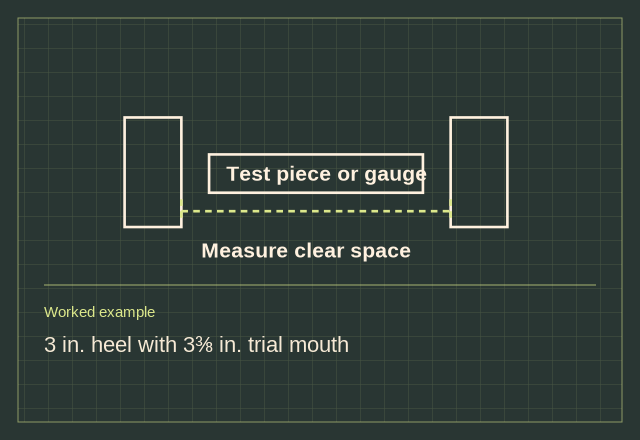
Two original 1/16-inch pads reduce the 3⅜-inch mouth to 3¼ in. For the same trial, replacing both with ⅛-inch material would reduce the opening to 3⅛ in., leaving only ⅛ in. around a three-inch heel at the entrance. The material also takes up space farther into the throat if it spans that area. Lay samples over the same card and move the empty boot until it first meets both sides. Mark the new landing point relative to the heel seam. If a curved pad changes that landing point, revise the shape or match the original pad thickness before you commit the new liner.
Practice on a plan
Finished dimensions in width × depth × height order.