Choosing stock · 2 min read
Rough vs. Surfaced Lumber for a Small Project
Should I buy rough or surfaced lumber for one small build?
Offcut Journal editorialUpdated
Short answer
Use surfaced lumber when the shop already offers a straight, sound blank close to your cut list and the price difference buys useful time. Rough lumber can give you more control over the resulting faces, provided you can still reach the required dimensions after making them flat and parallel.
At the bench
Find the tightest place
Take thickness readings at more than one point. Look along both faces and ends for a slight curve or a diagonal twist. A bulge can make the thickest place look promising while the thinnest usable area sets the limit. For a pair of matching rails, both blanks need to finish at the same thickness and keep a reliable reference face.
Decide who does the preparation
Stock labeled surfaced may still need its ends trimmed and a straight reference edge established. Check the particular board before paying a premium. If the shop can supply straight stock at the size your project needs, ask what faces and edges have been machined and how dimensions are stated. Quote the finished thickness you need when comparing different sellers.
Compare the width after cleanup
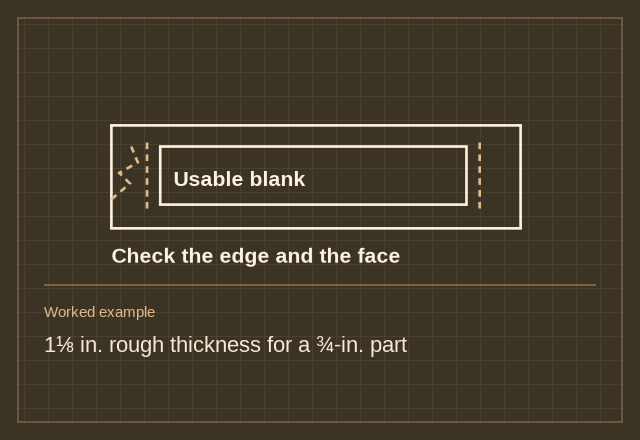
A rough edge can wander enough to make the middle of the board narrower than either end. Lay a straight rule inside the edge you want to keep and look for the tightest point along the blank. That real clear width determines which parts are possible. Use a pencil to mark the lengths where a full-width rectangle actually fits.
Take the project's scale seriously
One straight blank may be the best purchase for a short story stick. A frame with four matching rails could justify preparing a single board to get consistent faces and thickness. Write down who will prepare the material, and keep the part sizes on the list as finished targets until you know the prepared stock is sound.
Ask a supplier to quote a matched set of blanks
When you lack the equipment to flatten the 1⅛ in. rough piece, ask the supplier for two straight blanks milled to a matching actual thickness and enough width and length for the cuts you will make. The quote for a finished ¾ in. pair may account for a larger part of the board than the part measurements imply. Before spending, write on your list which face and edge must be square, and ask which surfaces their price covers. Bring a small flat reference or check the pair together on a sound surface when you receive it. A matching set can save a setup, while a pair made from visibly different boards may still need sorting for appearance.
Practice on a plan
Finished dimensions in width × depth × height order.