Choosing stock · 2 min read
How to Read a BB Birch Plywood Listing
Does BB birch plywood mean the whole panel is birch?
Offcut Journal editorialUpdated
Short answer
Treat the face grade, the core and the adhesive use rating as separate things to check. A listing can name birch as the visible veneer without describing the layers underneath it. Ask for specifications for the product being sold, then inspect the actual piece where it will become a part.
At the bench
Check the supplier's own grade key
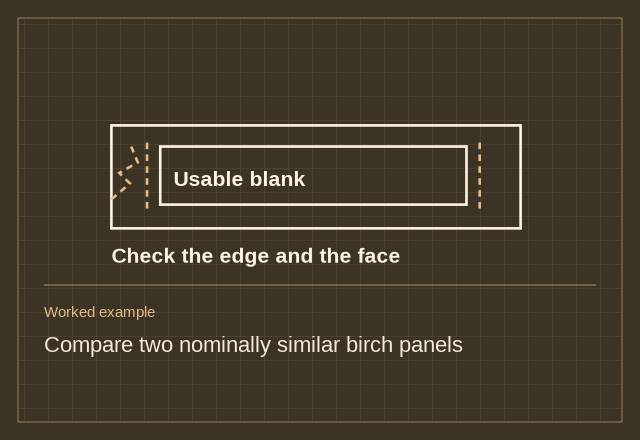
Letter grades can be tied to a particular standard or maker. Verify which standard the supplier uses and which repairs it permits on either face. A label telling you that a panel is birch says little about where a visible patch will land. Set out the widest show face against the actual panel and decide whether its repairs need to sit in waste or in an unseen area.
Identify how much of the core matters
A panel with a pretty front may suit a broad show surface if the stock beneath it is also sound for the job. A board with small features presents a tighter test. Look at the edges in the regions you can inspect and ask about the core across the entire sheet. Use a different piece for a critical feature if you cannot judge the stock with reasonable confidence.
Avoid paying for unseen advantages
For a panel that stays at the bottom of a display tray, an unblemished second show face may add little. For a project seen from both sides, both surfaces deserve a closer look. Write down what you will actually notice and handle. That list makes it easier to compare two descriptions full of different grading claims.
Buy enough of a known lot
When a few adjacent parts need to look alike, getting blanks from the same sheet can remove one source of visual variation. Tag the intended show sides and compare them in the same light. Keep a sound spare when the next visit to the supplier might yield another product under a similar name.
Confirm what the supplier can guarantee for the next sheet
Ask whether the listed face grade, core, thickness tolerance, and service rating apply to the exact sheet or just to a product family. On a small project with closely spaced recesses, buy a manageable sample if the supplier offers one. Compare the exposed edge, actual thickness, and surface at the part you mean to make. A shop with two apparently equivalent products can supply plywood that looks alike from above and behaves differently at the recess wall. Save the invoice or SKU with your cut list. If you remake a clearance-dependent part later, that record gives you a particular product to ask for and a thickness to measure.
Practice on a plan
Finished dimensions in width × depth × height order.