Choosing stock · 2 min read
How to Check a Plywood Core for Voids Before Cutting
How do I tell if an edge void will matter in a plywood part?
Offcut Journal editorialUpdated
Short answer
Find out where the opening lies relative to the feature you need. A void inside the waste area has a different practical consequence from one that will open into a narrow edge or the wall of a slot. A good-looking face gives you limited evidence about the core below it.
At the bench
Inspect all four existing edges
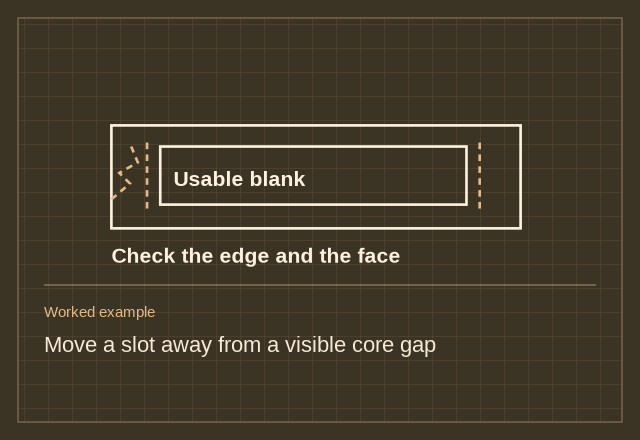
Look at contrasting ply lines and mark open gaps on a piece of tape. A rough cut can snag veneer and resemble a cavity. A clear edge shows whether the interruption is an actual opening between visible layers. Check the opposite edge as well, and carry forward only those conclusions you can see. Hidden voids can still appear when you cut into a different part of the sheet.
Give the important edge first choice
Locate openings, narrow lips, exposed corners and places where the design depends on a flat supported surface. Put these features in the best available area. Work from the full-size outline of the part. The critical edge may sit several inches from the edge you can inspect, so leave enough matching stock in reserve to remake the part if required.
Decide whether the issue is visual or functional
A small opening on a concealed edge that stays well away from contact and stress may be only cosmetic in a small project. A gap opening right at a bearing edge, slender lip or critical attachment zone deserves a fresh blank. Filler can make an edge look continuous. Choose material by the function of the original layers rather than by how well a patch can imitate them.
Inspect again after the first cuts
Keep important adjacent edges visible until the cutout is complete. If a gap appears in your new edge, check exactly where the plan places contact or motion. A strip that will touch a moving insert deserves even support. Use another part of the sheet where you can keep the same intended dimensions and grain direction.
Check the edge that a shallow hole leaves behind
A hole near the edge can put the core under a tighter constraint than a broad panel does. Draw the planned opening on a full-size pattern and mark the strip left between the hole wall and the outside edge. If the visible plywood core has an opening in that narrow strip, you want a different blank or an approved layout where sound material remains around the hole. A plug that hides the end of the void does little to tell you how far it extends inside. If the other panel edge is inaccessible, keep another blank available and inspect the first exposed layers after making a comparable setup cut in matching scrap.
Practice on a plan
Finished dimensions in width × depth × height order.