Fixes at the bench · 3 min read
Why an open book slides out of its rest
Why does a book sit securely shut on a wooden stand but push forward when I open it?
Offcut Journal editorialUpdated
Short answer
Opening a book changes which part of its cover touches the upright and which part rests on the shelf. A stiff spine can lift the middle off the shelf while the first few pages try closing again. Thin paperbacks and thick hardbacks can fail in different directions. Test a light book with a similar binding first, close to the center of its pages. Watch the bottom edge as you release pressure slowly with both hands.
Find the cause
Inspect the book against a straight reference
Open the practice book on a clean table with its covers supported and keep the binding at a comfortable angle. Look along the lower edge. Mark on a slip of paper where the bottom edge stops being flat or where the hinge forms a raised arc. Lay that paper on the stand’s shelf to see whether this part of the book will sit before, on, or over the front stop.
Find the useful back contact
Rest the book against the upright and keep fingertips around the outer covers while you lower its weight gradually. A cover may touch near the top while the lower part hangs forward. A soft, clean folded cloth can temporarily support the spine at that lower gap. If that changes where the book sits, decide whether a broader rest or a horizontal support suits that binding.
Check early, middle and late pages
The heavier side changes as you turn pages. Repeat near the front and near the back of the practice book. See if the thinner side lifts over the stop, or if the rest twists as the center of weight moves. Use only gentle support. Open valuable or stiff bound volumes as far as they move comfortably and keep them supported throughout.
Keep the stop where it meets the book
Before adding height, use a scrap of smooth card to represent the proposed top of the stop. Check that it meets a cover or lower page margin without obscuring text or lifting the whole volume. If the cover never reaches the stop cleanly, change the shelf support or use an angled reading surface of suitable size.
Leave room for a page turn over the stop
A book can fit neatly behind the stop until a reader puts a hand low on a page to turn it. Try the motion with the practice book open to the section you generally use. Support the book with the other hand and watch whether your thumb has to lift a cover up and over the stop to reach the page. If that movement consistently shifts the book forward, a higher stop could reduce access. A deeper or more gently inclined reading surface may be a better match. Choose the support that lets you release a page and read hands-free again without having to reseat the book.
Practice on a plan
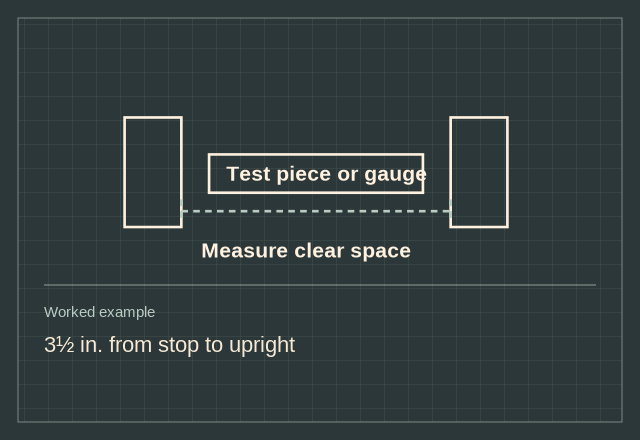
Finished dimensions in width × depth × height order.