Measuring and layout · 3 min read
How to Check a Face-Frame Cabinet Before Sizing a Wooden Rack
How do I measure a face-frame cabinet for a freestanding rack that must sit behind its front lip?
Offcut Journal editorialUpdated
Short answer
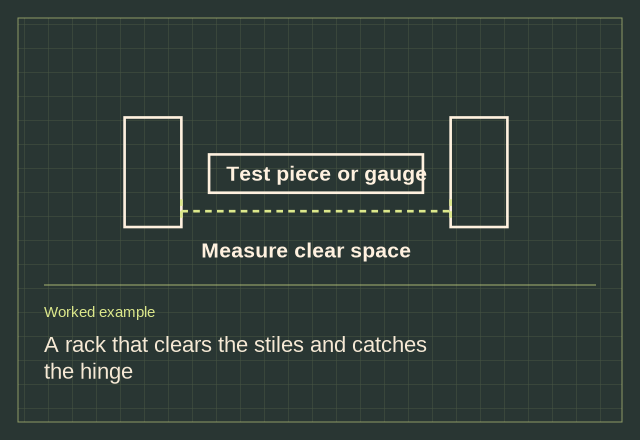
Record two outlines. First mark the usable interior at the rack’s resting height. Then measure the opening in its own plane, including any stiles or hardware that project there. A larger space behind the front frame can accommodate the parked rack even though the complete rack cannot enter straight from the front.
At the bench
Measure at the height of the actual rack
Set a scrap the same thickness as any shelf liner or raised base. Take the entry width at the bottom and top of the proposed object. Repeat closer to the interior walls. Use a square to measure how far the stiles protrude into the depth and mark that on an overhead sketch. Include any fixed center post or hinge bracket.
Draw separate frames for rest and approach
Mark the inner outline with an arrow pointing toward the door. Use a second line style for the narrower face opening. Test a stiff footprint with scrap blocks screwed or temporarily fixed at the corners to represent height. Move the complete model through from the intended side, watching for hardware along the path.
Account for moving objects around the rack
Open the cabinet door only to its normal stop and leave neighboring contents where they normally stand. Try reaching into the mock-up to grab the object furthest back. A removable rack may need a route to clear the door swing and the front lip used during normal operation. Mark where you need to grip the rack to get it back out.
Transfer the shortest clear width before the interior width
If a static rack can be assembled inside but cannot come out, decide whether you need service access for cleaning or finish inspection. A loose tray usually benefits from enough room to leave fully assembled. Mark the width that governs your choice on the cut list notes and double-check the real location when the shelf position changes.
Measure every restriction at the rack’s height
The ⅜ in. in the example is a measurement for that cabinet. Hinge manuals such as Blum’s show separate door and hinge-arm protrusion, and the mounting arrangement and opening angle affect what is in the way. Put the actual door at the stop you use and check the space across both boundaries at the same depth and height. Transfer each restriction onto the same front-to-back sketch so room behind the hinge does not hide a pinch point at it.
Try a handle at the height where it can interfere
A 12¼ in. body leaves ⅛ in. total at the example hinge. A ¼ in. side handle at that height makes the widest section 12½ in. and leaves it ⅛ in. too wide. Tape a folded piece of card to the model where the hardware would go. If the model only passes when turned or tipped, repeat the move with its full height and depth represented. A flat footprint cannot show what the top corner does. Slide the model into its parked spot, then take it back out the way you will when the rack is in use.
Map the swing path when the cabinet door stays on
The 13-inch rack in the example misses the 12¾-inch straight entry. Before buying wood for a turned entry, tape a 13-inch-long trial rectangle to a stiff tall mock-up representing the full depth and height of the intended rack. Keep the cabinet door open only as far as you usually allow it to go. Watch the leading corner as you turn the model and check whether the trailing corner reaches a hinge arm or the door face. Mark the normal extraction path before accepting a fit that requires taking a door off. If you sometimes remove the rack for cleaning, an everyday route matters as much as where it settles.
Practice on a plan
Finished dimensions in width × depth × height order.