Choosing stock · 3 min read
How to Plan Matched Sets of Wood Parts From One Board
How can I cut matching rails or feet so their color and grain stay consistent?
Offcut Journal editorialUpdated
Short answer
Map repeats on the board while it is whole. A blank can match its neighbor in width and still differ noticeably in color, grain, or edge appearance. Choose one visual pairing rule and reserve enough clear material to replace a member if one piece comes up short.
At the bench
Set the pair's viewing position
Place two paper windows on the rough board, sized to the finished faces. If the parts sit at opposing ends of a stand, keep their contact faces in the same orientation that they will have in use. Look along one wall of the room where the shadows will fall. Two boards chosen under overhead bench light can become dissimilar near a window because they throw highlights at different angles.
Use board continuity where it matters
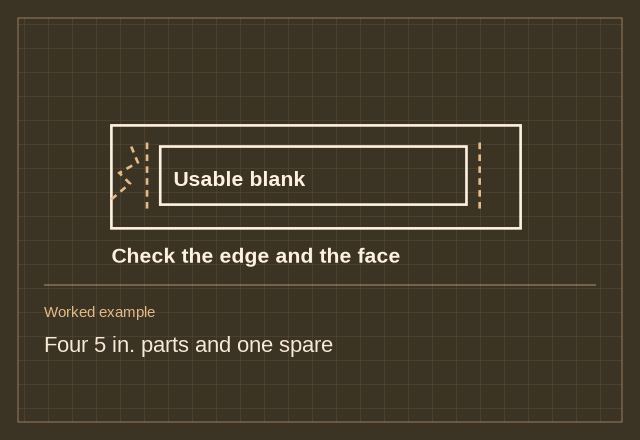
The grain may run parallel to an edge at one end and curve toward a branch at the other. Find a run that supports two or more full-size rectangles with trim allowance after avoiding defects. Put the most visible partner blanks in adjacent sound positions. Reserve the next-most-similar piece for replacement, with enough stock for its full finished size. If a pair must carry a reference edge, check that edge on a second face too.
Write positions on hidden areas
Reference labels such as outer left, outer right, inside left and spare are useful when the same part appears four times in a cut list. Add a face arrow and identify the edge you matched. A low-tack tape label can be carried to the cleaned part when the original layout marks disappear. Avoid stacking all the pieces in one pile if the top face can be confused with a mating surface.
Judge the pair after the first cleanup
Dry-position the parts at their eventual height, set the intended objects in place and compare one sightline at a time. If the color shift registers as a mistake, a spare from the mapped neighboring stock can replace the weaker match. When there is no suitable spare and all parts meet the dimensions, test a symmetrical arrangement before buying a second board.
Decide which pair the spare should be able to replace
Set the pale and dark sample groups in order before marking the fifth 5-inch blank as a spare. A pale spare suits the inner pair in the worked arrangement, while a replacement for an outer brown piece would need a similar brown position and full usable dimensions. If the outside pair matters most, price a second spare from compatible stock or reserve enough sound brown to redraw the entire outer pair later. Record the spare's intended position and its show face on the cut list. This prevents a measured spare from becoming the wrong visual match after the remaining board is used on something else.
Practice on a plan
Finished dimensions in width × depth × height order.