Measuring and layout · 4 min read
How to Set the Height of a Wooden Headphone Stand
How high should a headphone stand be so the earcups clear the base?
Offcut Journal editorialUpdated
Short answer
Measure where the loaded headband rests on the saddle, then measure down to the lowest cup or attached plug. Subtract that drop from the height above the surface beneath it. Check both the parked headset and the extra movement it needs when you lift it off under the shelf.
At the bench
Choose the headband reference point
Rest the headband on a temporary broad support. Find where it settles without squeezing the cushions together. A narrow dowel may sit higher inside a curved band than the broad wooden top you plan to make. Use a scrap pad close to the planned support size before recording the drop. Measure from the actual contact surface.
Check the cups in a relaxed position
Let the cups swivel on their own. Look from the side and mark the part that hangs lowest. A plug can extend below the padding and its cable may take up more height than the shell. If you remove the cable to park the headphones, record that as part of the setup instead of designing around a disconnected position you rarely use.
Mark front and back depth with paper
Place a sheet under the trial support and mark the outer corners of both cups. Use the tracing to choose a stand location on the desk. The headset may overhang a narrow base while still being fine in a clear space. If it brushes a monitor stand or wall, move the parked position or use a wider desk location before changing the wood dimensions.
Rehearse the lift above the support
Stand the mock-up where the finished holder will go and lift the headphones off with your usual hand. Watch the headband and any shelf above. Raising the stand might resolve clearance below while taking away the useful space above. Record the resting height and the removal height separately and compare both against the actual space.
Mark the bearing point and the surface below the plug
Use masking tape on the saddle mock-up to mark where the headband actually touches it. A soft pad can move that spot once the headphones settle. Put a square against the base or the top of any raised lip and write down the height to the bearing point. Separately hold a rule beside the hanging cups with its zero at that contact, and read down to the lowest cup, jack or plug. Let the headset swivel naturally if its cups can pivot. Sony documents those movements for specific models. Your own headset and lead supply the measurements.
Prove the taller version under the shelf
A 10¾ in. trial saddle leaves ⅜ in. beneath the example plug. That extra height helps only if the headset can still clear the shelf during removal. Mock up the taller saddle with the full base thickness and the planned pad. Lift until the headband clears the saddle, then take the headset out and return it with your normal grip. If the plug is free at rest but knocks the shelf during removal, move the stand forward, use a compatible slimmer cable if appropriate, or change the support arrangement before changing the plan.
Read the published stand dimensions from their own marks
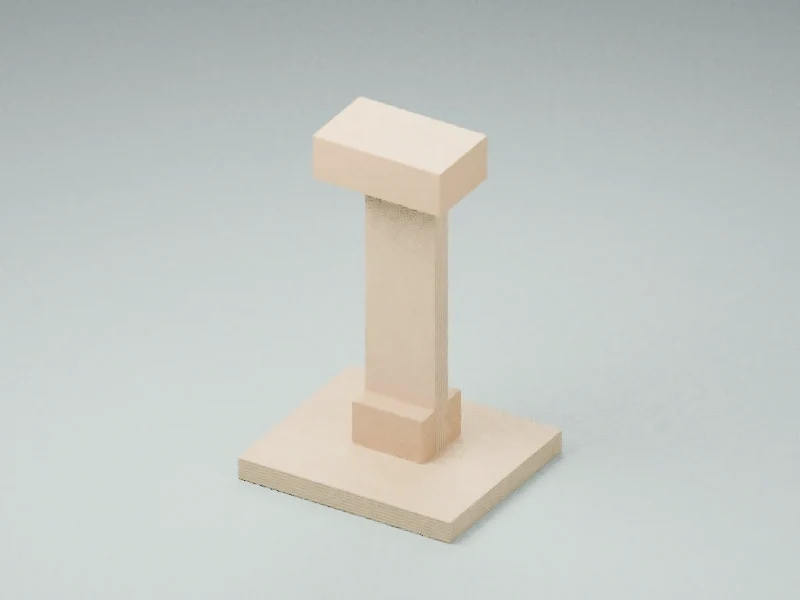
Offcut’s freestanding headphone rest is 11½ in. overall and has 9¼ in. to the underside of the saddle above the base. Those numbers locate the wood parts on the published drawing. For the clearance calculation, mark the loaded bearing point on your particular saddle and measure to that. Recheck after changing the saddle’s shape or adding a soft pad.
Measure where a stand pad changes the drop
The example’s ¾ in. of clearance comes from subtracting the 9½-inch drop from the 10¼-inch support height. If you add a soft pad to the top, let the headset settle before measuring the two distances again. Its headband might rest on the ends of a curved pad and occupy a higher spot than the pad’s thickest point suggests. A base pad can also hold the headset above the desk without changing its clearance above the wood. Let the headset rotate a little as you check whether a cup will hit a nearby raised edge. Use the reference that matches the surface it could actually touch.
Practice on a plan
Finished dimensions in width × depth × height order.