Sanding and finish · 2 min read
How to Estimate Finish for a Small Wood Project
How much wood finish should I buy for a small project?
Offcut Journal editorialUpdated
Short answer
Calculate the area you will coat and use the coverage on the exact product’s label or technical sheet. Work one layer at a time. Include the test pieces in the estimate, and treat the calculation as a purchasing guide rather than an application measurement.
At the bench
Draw every exposed surface
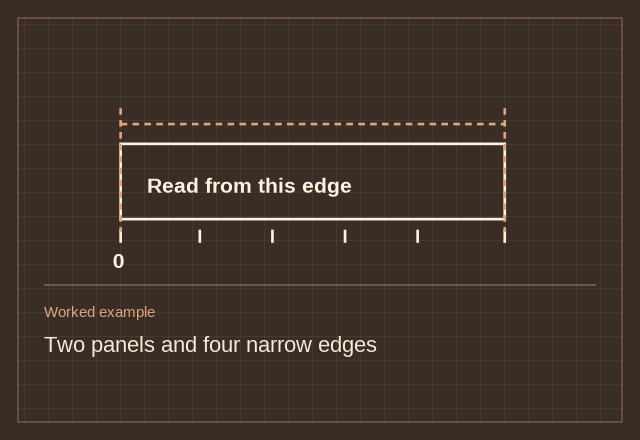
List a finished face once. Include a back or underside if that surface is part of your coating plan. List its regular rectangle or narrow edge dimension and mark the masked surfaces. For a complicated frame you can split each side into rectangular spans, doing the same accounting on both sides of the assembly.
Keep area units straight
When using inches for the part dimensions and square feet for label coverage, divide your square inches by 144. Read the coverage units carefully. If the product gives area per gallon or liter, keep the numerator and denominator consistent as you calculate. Use the tape or plan sizes for the finished piece, including edge thickness in each narrow rectangle.
Run the numbers for every layer
Take each layer and its stated coverage separately. A base layer may change the next layer’s surface, so read how the manufacturer describes coverage and approved number of coats. For a range, use the lower area per unit when planning how much to buy if your particular surface may require it. Add scrap pieces and consider likely loss in the application supplies.
Write the budget next to the cut list
Record your exposed area and the product under consideration so you can update the calculation after changing a panel width. Buy a package size that will cover the tested schedule with a little practical room for setup. During application, use the recommended film thickness and technique. The arithmetic guides the purchase.
Calculate the sample pieces before choosing a container
Add your test pieces to the estimate with the same area method. For a four-by-six-inch scrap finished on both broad faces, count 48 square inches before adding exposed edges, or one third of a square foot. At the hypothetical coverage of one square foot per fluid ounce, two such broad-face coats account for about two thirds of a fluid ounce. Exposed edges and other swatches add to the estimate. Keep the label’s coverage and units beside the figures. Make a separate line for a compatible primer, stain, or another topcoat with different coverage. Their estimated volumes answer different purchasing questions.
Practice on a plan
Finished dimensions in width × depth × height order.
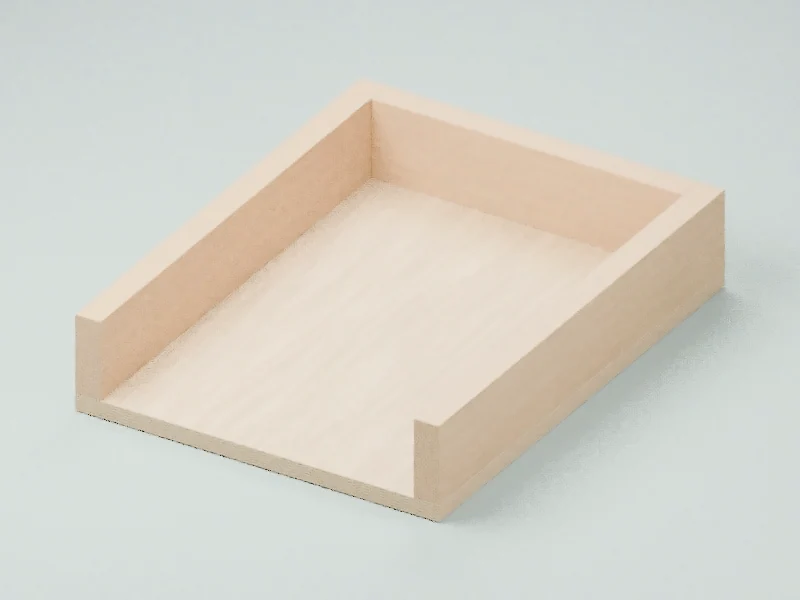 Open-Front Wooden Paper Tray for US LetterFinished size · 10½ × 13½ × 2¾ in.
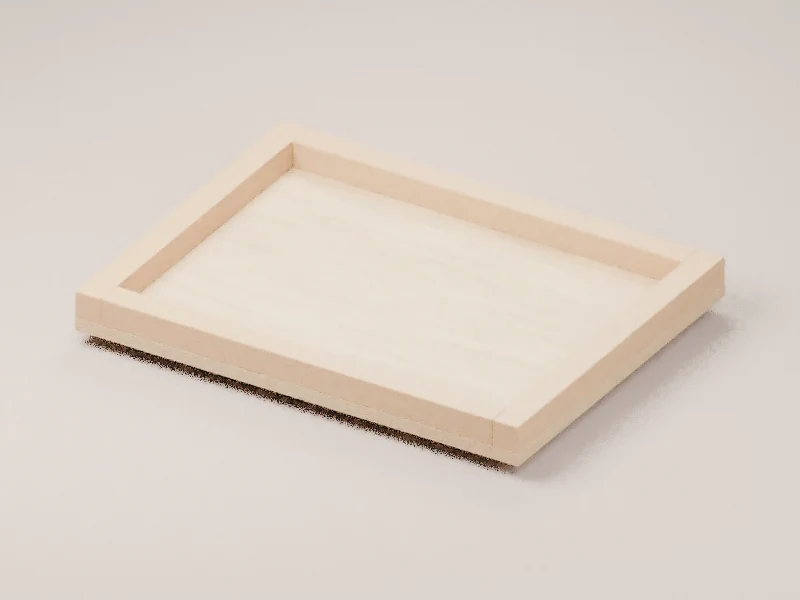 Wooden Jigsaw Puzzle Sorting Trays That StackFinished size · 8½ × 6½ × 1 in.