Measuring and layout · 2 min read
How to Divide an Awkward Width With a Diagonal Ruler
How do I mark equal divisions across a board width that does not divide cleanly on the ruler?
Offcut Journal editorialUpdated
Short answer
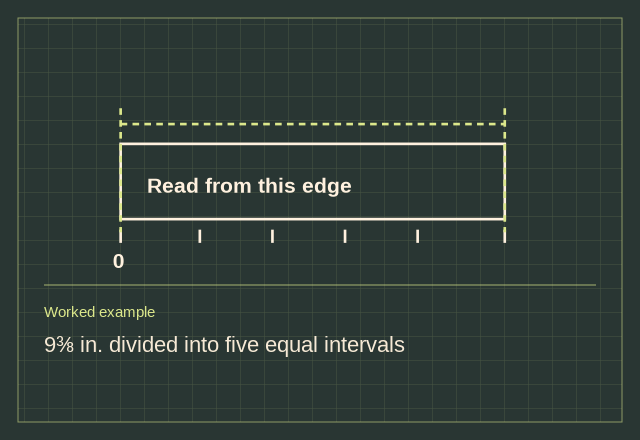
Set a ruler diagonally between the two boundaries until it spans a reading divisible by the number of divisions. Note those easy marks along the ruler, then project them onto a true crosswise line. The angled ruler gives you the proportion along the board. Measure along the crosswise line when you need the actual spacing.
At the bench
Choose the limits of the useful area
Draw a line across the panel square to a straight reference edge. Mark the two boundaries used by the design. They may be centered inside the panel rather than at its outer edges. For instance, screw or spacer margins might stay outside the divided space. Keep both separate from the ruler reading.
Tilt the ruler without changing the endpoints
Set zero at one boundary and turn the ruler until the easy division number reaches the other boundary. The ruler must be longer along the diagonal than the true length of the span. Keep it flat. If the planned diagonal lands off the end of a short board, use stiff paper against the reference rather than trying to measure in the air.
Project marks perpendicular to the crosswise line
Mark the easy readings with a fine pencil on the diagonal. Use a square or parallel lines to carry those marks to the crosswise line and check their positions. Each projected mark should share the same x position as its diagonal mark. Avoid following a series of short angled strokes freehand. The method depends on consistent projection.
Distinguish center spacing from open space
The ruler has produced centers or boundaries. If dividers have thickness, mark both faces around each center and calculate what space remains. If the open spaces must be equal between pieces of unequal thickness, budget those widths individually first. Verify the first and last positions from the same datum and compare two middle intervals before moving from pencil lines to workpieces.
Translate five center intervals into four dividers
On the 9⅜-inch example span, the four interior marks land 1⅞, 3¾, 5⅝, and 7½ in. from the first boundary. If each interior mark centers a ¼-inch divider, mark its faces ⅛ in. to either side. Each space between two dividers is then 1⅝ in. wide, while the outer spaces are 1¾ in. if the boundaries themselves are open faces. Draw real divider widths onto the trial layout and check the first, middle, and last bays with the intended object. If the clear widths all need to match, use the inside faces and allocate the divider material before spacing the bays.
Practice on a plan
Finished dimensions in width × depth × height order.