Choosing stock · 3 min read
How to Screen Reclaimed Wood for a Small Indoor Build
When is a scrap of reclaimed wood sensible to bring into a small indoor woodworking project?
Offcut Journal editorialUpdated
Short answer
Use clean, dry stock whose previous use and construction you can identify. Board appearance and weathering do not establish what the wood contains. Start with an offcut from a documented interior project when the piece will be near books, clothing, or other frequently handled objects.
At the bench
Ask about history before material identity
Find out what the piece was, where it lived, what contacted it, and what was applied to it. Indoor plain lumber you cut yourself has a known history. Roadside stock and used exterior timbers may not give you enough information to work safely. Treatment may be undocumented and a familiar looking grain can be any number of species. Skip material with uncertain coatings, strong odors, signs of active insects, significant staining of unknown origin, or a history that suggests chemical exposure.
Check for fasteners after a clean history is confirmed
Study faces, edges, and end grain under good light. Nail holes, black marks around a hole, embedded staple crowns, snapped screw heads, and trim brads can be hard to see. A metal detector can add information on known clean stock, and a quiet reading leaves the need for a visual check. If a potential fastener sits in a planned blank or tool path and you cannot account for it, leave that piece out of the build.
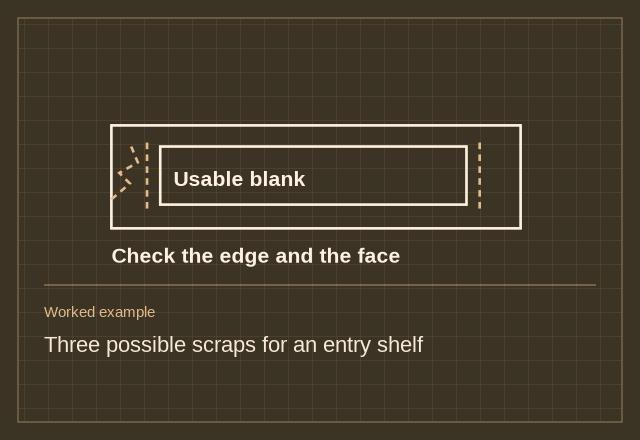
Draw the blank on a known good face
Lay the plan part outline on the stock after setting aside damage, glue residues and old fastener zones. Measure the actual solid rectangle that survives at both ends. Count narrow profile molding as the usable flat width after leaving off decorative shape unless the exact form suits the intended role. Explore one reversible small object first, such as a loose shelf spacer, if you have a clean piece with dimensions short of a whole main part.
Preserve the history across the scrap pile
Write the source on a hidden area with the date or project name and photograph it alongside its label if one exists. Gather the remaining offcuts together so future you can distinguish them from pieces without a traceable history. If a questioned stock piece already sits in your pile, set it aside without machining it and follow the applicable local handling and disposal guidance for the material if you can identify it.
Keep new blanks identifiable when the label is trimmed away
Give a known clean cabinet or casing offcut a short project name before laying out several small blanks. Write the same name on a paper slip beside the grain, then take one photograph that shows the label, the reference face, and the planned cuts. Move each blank to its own labeled position as soon as it is separated. This makes it possible to keep the known clean spacer with its evidence even when the printed label was on a narrow edge that comes off. A piece whose history remains unclear belongs in a separate area before any machining decisions begin.
Practice on a plan
Finished dimensions in width × depth × height order.