Choosing stock · 3 min read
How to Reuse Known Cabinet Plywood Offcuts
Which parts of a known cabinet offcut are worth keeping for a small indoor build?
Offcut Journal editorialUpdated
Short answer
Start with a clean offcut from cabinet stock you can identify. Reserve the actual flat, supported rectangle, leave former hole positions and adhesive ridges out of the new blank, and use the existing face as a design constraint when you choose each part.
At the bench
Establish exactly what the cabinet panel is
Check any remaining label or build notes for panel construction and surface treatment. A cabinet part could use veneer over a plywood core, thin laminate, a plastic facing, or an applied film. Their edges differ even when all faces were sold under the same color name. If the new plan expects a solid wooden edge to carry a fastener or match an existing face, keep the part specified by the plan until the substituted construction is understood.
Use good finished surfaces where they help
A clear face you already have may make sense on a lightweight back panel facing a wall. A slick, known factory-coated face may be easier to wipe at a recipe holder's outer side. Some finish surfaces complicate glue and are best kept out of mating faces. Mark the intended outside face and all existing surfaces in any proposed bond area. Compare the stock and adhesive instructions before committing to a role that needs components bonded together.
Draw around holes and crushed edges
Lay out with a wide pencil line on masking tape or paper, then confirm the part rectangle with a ruler. An old shallow shelf pin hole is different from a through-hole and may get surprisingly close to the surviving face when a narrow piece is proposed. Inspect both faces and cut edges of the available material. Add enough trimming space to remove protruding band seams or crushed fibers where the plan needs a straight working edge.
Confirm thickness at the places that matter
Measure the offcut near opposite edges and the middle without relying on the old cabinet label. Compare measurements at a slot, a bearing surface, and any part that shares an edge with another piece. Existing face layers contribute to the measurement. If actual thickness changes a gap or register called out in the plan, use the scrap for an accessory or a noncritical face that meets its existing dimensions instead.
Check the finished face against the new edge orientation
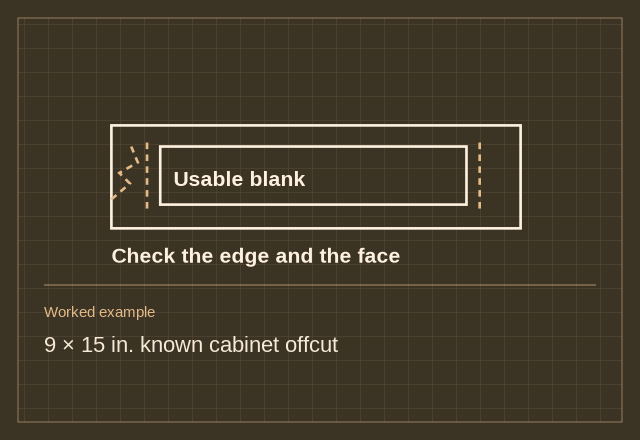
Hold a clear sample from the 9 × 15-inch cabinet offcut beside the rest of the project where its new edge will be visible. The old band may face a wall in the cabinet and become the front edge on a recipe holder. Draw the 6 × 12-inch clear rectangle with its new front marked and note where it would expose a raw edge instead. Compare what the plan requires at that edge, including any glued parts or contact with paper. Choose the orientation that leaves the useful original face where you can use it while keeping the needed edge and its trim inside the solid rectangle.
Practice on a plan
Finished dimensions in width × depth × height order.