Fixes at the bench · 3 min read
Why leather turns in a stitching holder
Why does the leather twist in the holder between two points on the seam?
Offcut Journal editorialUpdated
Short answer
A pair of jaws can grip along one small point of a thick glued seam and offer little support farther down the piece. A soft lining can hide that gap until you pull thread a few stitches away. Make a trial piece from similar layers with a marked seam line. Put the needles down and remove thread tension before adjusting the holder. Work on a stable table with space to reposition the piece.
Find the cause
Find where the jaws first hold
Place the trial piece at your normal sewing height and close the jaws gently. Pull each paper strip from outside the closure. If a strip slips out on the thin side while the thick side stays held, adjust the position so both jaws bear on more of a straight section. If the holder sits twisted before any leather goes in, check that it is fully supported on the tabletop.
Observe the motion on a marked scrap
Draw a reference line perpendicular to the top of the trial piece with ordinary tailor's marking material suitable for the scrap. Give the leather a small hand pull in the directions you normally draw the thread. The line shows whether the piece slips downward or turns around a single fixed high spot in the jaw. Try this without a needle or other sharp object near the jaws.
Check the lining as a separate part
Open the jaws and inspect both pads. A lifted corner, a compressed strip or a finish on the pad can give one side a different contact area. Compare against clean removable trial pads where appropriate for the holder. Keep the pad height below your seam and avoid any attachment detail where a needle could catch.
Change position along a long seam
Move the piece in small sections so your stitching stays near the well-supported area. Keep the next few holes visible above the jaws. Use a separate support for any long tail that pulls on the clamped end. Practice opening and closing with no needles in hand before putting the real piece back.
Balance a long strip before changing the jaw gap
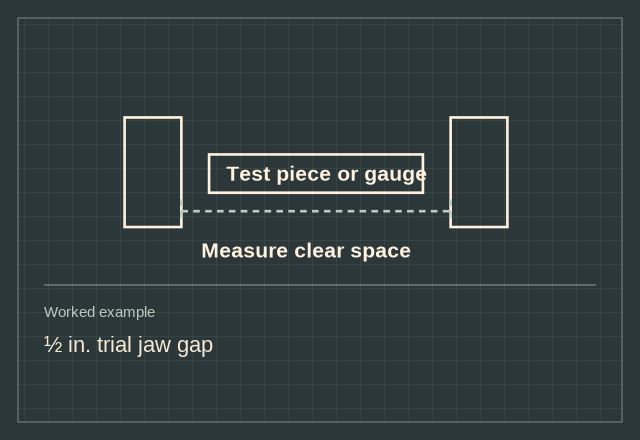
A long strap can pull the stitch line sideways simply by hanging off the table. With the needles set down, clamp a scrap long enough to bow in the same direction and support its tail on a clean, stable surface just below the work. Compare the marked stitch line with and without that support. If the line remains steady when the tail is carried, keep the jaws in the same slot and leave room for the strap to follow as you advance the seam. A support that is higher than the clamped seam can create new upthrust, so check the line again as you let go.
Practice on a plan
Finished dimensions in width × depth × height order.