Choosing stock · 2 min read
How to Spot Grain Runout in Narrow Wood Parts
How can I tell whether grain runs out of a narrow wood rail?
Offcut Journal editorialUpdated
Short answer
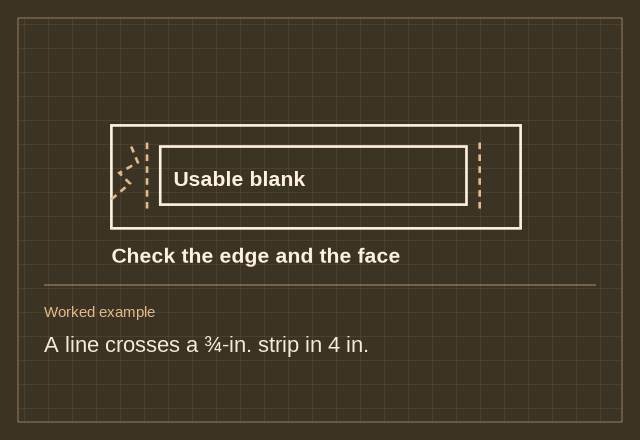
Grain runout becomes easier to see when a plank outline is marked. Follow a few visible fiber lines along the length and watch where they leave that outline. Check the edge and face together, because a board can look straight in one view while its fibers angle out in another.
At the bench
Use the grain lines you can follow
Bold cathedral figure is a pattern you see on the face, and it may obscure where individual fibers actually travel. Find finer elongated marks or a reasonably clear edge that lets you follow them. Turn the board and check the second view. A dark streak alone gives you little information about whether the grain runs along the pencil outline.
Watch what happens near a knot
Grain can bend around a knot well beyond the visible dark center. Separate the small part's usable outline from that bend, especially where the piece gets narrower or will project freely. A broad blank may give you room to shift the layout sideways so a useful straight section supplies the critical length.
Look at the smallest section
A wide rail cut to a narrow tongue or shaped point will lose material at its weakest-looking region. Mark the final outline as well as the rough rectangle. Check which fibers remain inside the narrow shape after the waste is gone. Give your clearest material to this slender portion before picking stock for wider pieces.
Change the orientation deliberately
Rotating a narrow blank on a board may bring it into line with the fibers. Check that the new diagonal placement still leaves room for its neighbors and can be cut using a safe support setup. Draw the full blank first. If a layout depends on saving a tiny sliver, a different section of stock may be a simpler choice.
Give the shaped end a separate stock outline
A plant marker often narrows toward its point. Draw the finished taper inside one outline for the 9 in. marker, then inspect the side edge immediately above that taper. A piece with a grain line running diagonally into the point might leave only short fibers on one side when the point is shaped. For a small dry-use marker you can choose a straighter region or make a shorter shape where the original design allows. For a loaded pin or slender projection, keep the specified geometry and stock. Mark a clear spare beside the main blank so rejecting a doubtful tip does not send you back to the same questionable stretch.
Practice on a plan
Finished dimensions in width × depth × height order.