Choosing stock · 3 min read
How to Measure Usable Lumber Width Around Wane
Does the listed lumber width include the rounded bark edge?
Offcut Journal editorialUpdated
Short answer
Lay out the finished blank inside an area with full-thickness wood across both faces. A board's widest surface measurement can include part of a natural outside curve where no full square corner survives.
At the bench
Find where the missing corner crosses the outline
Wane describes missing wood or bark at the edge after the log becomes a board. Follow it by looking along the narrow edge with light raking across the stock. Thin back-face bark can blend into dark figure. If the part must have a full-width contact face at its back, use the inner end of the sound wood boundary as the limit and inspect the entire project length.
Establish one edge on paper
Draw a candidate straight line through the clear area on the board with a straightedge. Measure at right angles to it from the opposite limit, checking both faces every few inches and wherever the edge changes direction. The smallest measurement limits any uninterrupted strip along that line. A very slightly turned line may find a wider continuous rectangle. Keep enough length to locate that rectangle without encroaching on end damage or missing corners.
Apply the part's reference requirements
A wood face can appear flat and continuous from the front while the corresponding corner is missing where a square registers. A strip that must sit against another part with square contact needs a full edge over that length. A deliberate decorative area on broader parts may show an intact natural outline if the rest of the plan is unaffected. Do not count bark or weak wood as support, and skip uncertain bark on frequently handled items.
Board choices for short parts
If no whole long outline fits, lay out independent short rectangles clear of the wavering edge. Consider marking the wide side and grain orientation of each so parts with matching dimensions stay predictable. Wider stock is worth buying when your project needs repeated square faces from one straight reference. You can keep the remaining sound offcut for a shorter unrelated job with its actual width marked on the back.
Deduct edge cleanup from the width you measured
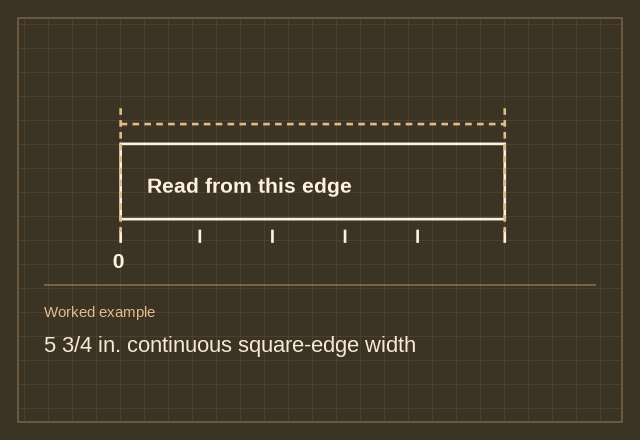
Keep the solid-width reading and finished width on separate lines. In the worked example, the widest continuous square-edged rectangle is 5¾ inches before cleanup. If you expect to lose ⅛ inch at each side, the finished width available would be 5½ inches. A part that needs the full 5¾ inches still needs another blank in that example. Move the pattern or choose another board when the solid width leaves too little margin. Recheck the narrowest point after drawing the new reference edge, since adjusting the angle can move the limiting section along the board.
Practice on a plan
Finished dimensions in width × depth × height order.