Choosing stock · 3 min read
Edge-Glued Project Panel vs. Plywood for a Small Build
Is a solid edge-glued project panel an interchangeable substitute for plywood?
Offcut Journal editorialUpdated
Short answer
Read the panel's construction and grain. A solid edge-glued panel is made of narrow wood strips glued side by side. It still moves with moisture, especially across the grain. Cross-laminated plywood behaves differently, so a panel cut to the same size and thickness can need a different assembly.
At the bench
Read the edge before the label
A project panel can refer to many constructions. The edge of an edge-glued board usually shows separate solid pieces side by side across the width. A plywood edge shows stacked veneers in depth, though some have a different core under the face. Factory edge treatment may conceal the build. Ask for the product sheet and look at an unbanded sample edge or smaller sample from the same material to establish how it is made.
Account for wide contact and fixed points
Trace the solid wood grain direction on the drawing. Then circle long captured sides, close-fitting columns, and widely spaced points that restrain movement. A floating center or slots designed for seasonal movement may allow a solid option when the plan calls for it. If you cannot establish that flexibility and the original panel is rigidly attached, select the original construction. Put existing clearances and attachment positions on the same copy of the drawing.
Keep the best face orientation separate
Solid wood can give similar appearance through its edge and can contain surprising changes in grain at each glued strip. Plywood can present a smoother, visually uninterrupted face while the stacked edge reveals a stripe. Check actual finished-width placement using a paper outline. Some project panels have seams or fingers on the show face that read strongly through a narrow strip. Compare both faces and visible edges from the final viewing position.
Decide by the planned job of that part
A removable platform, a stiff back, and a narrow divider can merit separate decisions. Avoid exchanging all panel items because one alternative works well for a loose piece. Keep the stated stock for parts that share a slot or face thickness unless measurements and the layout allow a deliberate change. Record species or panel type plus measured thickness on the cut list before the labels get discarded.
Compare the replacement blank at its slot and at its attachment
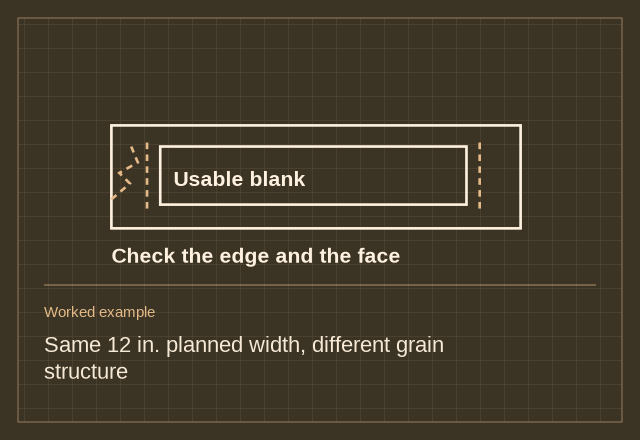
Try the proposed thickness in a scrap piece cut to match the slot, then draw both attachment points on the 12-inch back panel. A 23/32-inch plywood sample and a ¾-inch solid panel differ by 1/32 inch in thickness even before you consider seasonal movement. Passing the slot check tells you about present geometry. Inspect the drawing for whether the solid grain would be restrained between the fixed points as a separate step. Preserve the plywood in the rigid frame given in the example. A solid offcut that nearly matches the slot may belong on an independently supported accessory designed for it.
Practice on a plan
Finished dimensions in width × depth × height order.