Choosing stock · 2 min read
How Earlywood and Latewood Affect a Small Wood Surface
Why do some growth-ring bands wear differently under handling?
Offcut Journal editorialUpdated
Short answer
Earlywood and latewood can differ in density within one growth ring. The difference is easy to notice in some boards and barely visible in others. Look at the actual section that will be handled or rubbed and compare suitable alternate blanks for an even feel.
At the bench
Learn to see the band in the edge
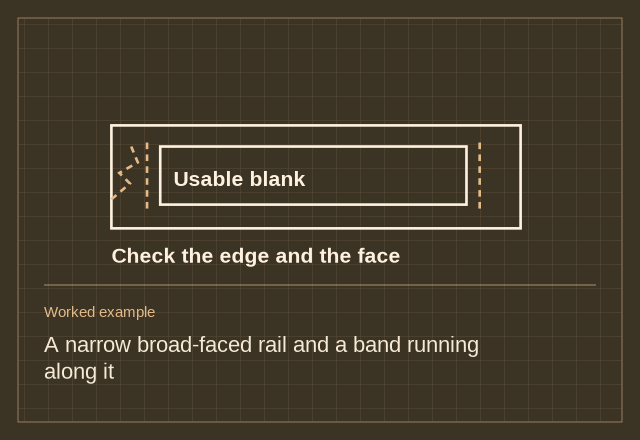
A face can show a repeating pattern without making it easy to tell how far a band extends into the blank. Look at the end and compare the growth rings with the stripes on the face. On a small part, a single band may span much of the contact area. Check what will remain visible when the required width is cut from the board.
Give handles and rests a separate inspection
A touch rail, fabric hook or small tool rest has a different role from a decorative lower board. Run a hand gently across the candidate where it is safe to do so, and check for bruised areas with raking light. Use your best continuous patch where something slides, rests or is moved often.
Keep the grain pattern you want
Some builders want a pronounced visible stripe because it lines up with the adjacent wood. Use a pencil outline to see whether the pattern reaches the corners cleanly or ends abruptly. For a pair, compare both layouts before making the first one. There is room to keep striking figure on broad faces whose function tolerates it.
Let a scrap trial answer a close call
Take two comparable scraps and try the normal kind of contact the final part will see. Check how they feel afterwards and look at their edges under the same light. Use those observations to pick a part for this build. Two scraps can help with a material choice, even though their response does not establish a lifespan or universal rule about the species.
Compare the contact after both candidates are prepared alike
An uneven strip left by a rougher sanding pass can look like a difference between growth bands. Mark a small trial area on two spare blanks, then prepare them by the same method to the same intended surface. Bring a piece of the actual contact material to the test, such as an expendable card sleeve or a swatch of similar cloth. Feel for catching and look for raised ridges before trying a comparison again across the grain. If the surface is uneven on both, put the visual figure on a separate decorative face and choose a smoother blank for the handled strip.
Practice on a plan
Finished dimensions in width × depth × height order.